Business Automation for Irish SMEs: How I Saved a Health & Safety Company an Hour Every Day (2026)
Every working day, someone at a health and safety training company sat down after a session and manually generated a completion certificate for every attendee, one by one. Then they opened a spreadsheet and filled in the attendance record by hand. It took between 30 minutes and an hour, every single day. I'm Mateusz Reglinski, a web developer based in Ireland running nefling.dev. I build websites and custom automations for small businesses across Ireland and the UK, and this is the story of how I eliminated that daily grind entirely. If you're spending time on repetitive admin tasks, this post is for you.
What is business automation and why does it matter for Irish SMEs?
Business automation means using software to handle tasks that a person would otherwise do manually: things like filling in templates, copying data between systems, generating documents, sending follow-up emails, or updating spreadsheets. The task still happens; a computer just does it instead of a person.
For Irish small and medium businesses, automation matters right now for a simple reason: most large competitors are already doing it, and the gap is widening. Only 12% of Irish small businesses currently use AI or automation tools, compared to 25% of medium businesses and 51% of large enterprises. That gap is a competitive window. The businesses that automate repetitive work free up staff time for higher-value activities like client relationships, sales, and the work that actually grows revenue.
The global picture tells the same story: 60% of companies have already automated at least one core process, and that figure is projected to reach 85% by 2029. In Ireland specifically, 91% of businesses have expressed intent to adopt AI and automation in the coming years. The question for most Irish SMEs isn't whether to automate; it's which tasks to start with.
The problem: 30-60 minutes of manual work, every single day
The client in this case study runs health and safety training sessions for businesses across Ireland. After every session, they need to produce two things: personalised completion certificates for each attendee, and an updated attendance register that records who was present.
Before the automation, the process looked like this:
- The trainer finished the session and collected the list of attendees
- Someone opened a certificate template and manually entered each attendee's name, the date, and the course details
- Each completed certificate was saved as a PDF individually
- The same information was entered into a separate attendance spreadsheet by hand
- This was repeated for every attendee at every session
For a session with 10 attendees, that's 10 certificates to fill in, 10 PDFs to save, and 10 rows to update in a spreadsheet, all done manually, all prone to typos, and all taking up the better part of an hour every day.
The person doing it wasn't unqualified or slow. The process was just genuinely that tedious, and there was no avoiding it.
The solution: automated certificate generation and attendance tracking
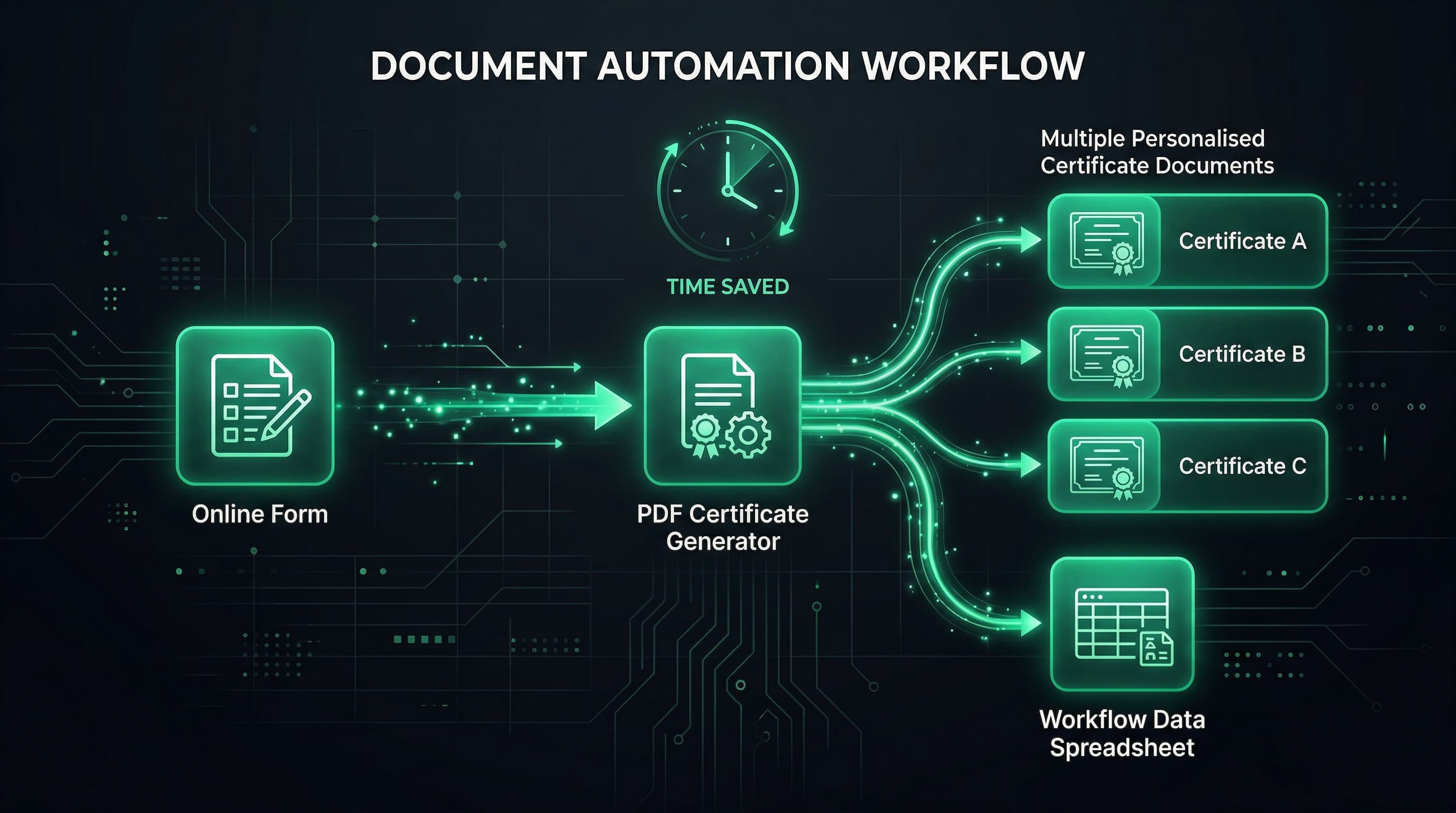
I built an automation using Google Apps Script combined with a workflow automation layer. Here's how it works now:
- The trainer submits a simple form with the session details and the list of attendees
- The automation reads the attendee list and generates a personalised PDF certificate for each person, with name, course title, date, all pre-filled
- At the same time, the attendance register is automatically updated with every attendee's details
- The whole thing runs in seconds
What used to take 30-60 minutes now takes as long as it takes to submit the form, which is about two minutes.
The certificates are generated from a template, so they look exactly the same as the manually produced ones: same layout, same branding, same formatting. The only difference is that a human no longer has to produce them one by one.
As an optional extension (and something I'll likely add in a future phase), the automation can also email each certificate directly to the attendee immediately after the session ends. No printing, no manual sending, and the certificate arrives in the attendee's inbox automatically.
What does this actually save in real terms?
The time saving is 30-60 minutes per day. That sounds modest, but add it up:
| Saving per day | Working days per year | Hours saved per year |
|---|---|---|
| 30 minutes | 230 | 115 hours |
| 45 minutes | 230 | 172 hours |
| 60 minutes | 230 | 230 hours |
At an Irish administrative wage of roughly €14-16 per hour, that's between €1,600 and €3,680 in labour cost recovered every year, from a single automation. That's before accounting for reduced errors (no more typos in certificates), faster turnaround for attendees, and the fact that the person doing the work can spend that time on something that actually moves the business forward.
The one-time cost to build the automation is a fraction of the first year's savings. Every year after that, the saving repeats at zero additional cost.
What else can be automated for Irish small businesses?
Certificate generation is one example. Here are the categories I see come up most often when working with Irish SMEs:
Document generation
Any time a business produces the same type of document repeatedly with different names, dates, or figures, that's a candidate for automation. Invoices, contracts, reports, certificates, quotations: all of these can be generated automatically from a data source and saved or sent without human involvement.
Data entry and synchronisation
Many businesses maintain the same information in multiple places: a spreadsheet, a CRM, a booking system, an email inbox. When someone makes a booking, someone manually copies the details into the spreadsheet. When an invoice is paid, someone manually marks it in two systems. Automation can keep these in sync in real time, eliminating double-entry entirely.
Notifications and follow-ups
Appointment reminders sent automatically the day before. Follow-up emails triggered three days after a quote is sent. Alerts when stock falls below a threshold. Notifications when a form is submitted. These are all triggers that a system can handle reliably, without anyone having to remember to do it.
Reporting
Weekly or monthly reports compiled automatically from existing data and delivered by email, instead of someone spending an hour pulling numbers together every Monday morning. If the data already exists in a spreadsheet or system, the report can usually be automated.
What tools are used for business automation in Ireland?
The right tool depends on what systems you're already using and how complex the automation needs to be.
Google Apps Script works best when your business already runs on Google Workspace (Gmail, Sheets, Docs, Drive). It's free, powerful for document generation tasks, and integrates tightly with Google's ecosystem. This is what I used for the certificate automation described above.
Make (formerly Integromat) is a European-based workflow automation platform that connects over 1,500 apps. It's stronger than Zapier for multi-step workflows and has a visual builder that makes it easier to reason about complex automations. Well-suited for connecting tools like CRMs, booking systems, email platforms, and accounting software.
Zapier is the most accessible option for non-technical teams. It handles simple "when X happens in one app, do Y in another app" workflows with minimal setup. 6,000+ integrations. Good starting point if your needs are straightforward.
Custom code (Node.js, Python) is the right choice when off-the-shelf tools can't handle the complexity: custom document templates, proprietary data formats, integrations with systems that don't have official APIs, or workflows that require business logic no platform supports out of the box. More upfront investment, but no ongoing subscription cost and no platform limitations.
How much does business automation cost in Ireland?
Cost depends heavily on the complexity of what's being automated and the tools involved.
Simple automations using existing platforms (Google Apps Script, Make, Zapier): typically €300-1,000 to build, with low or no ongoing platform cost. The certificate automation above sits in this range.
More complex automations involving custom code, multiple system integrations, or bespoke document generation: €1,000-5,000+ depending on scope.
The calculation that matters is ROI, not upfront cost. If an automation saves one person 30 minutes per day, it saves roughly 115 hours per year. At €15 per hour, that's €1,725 per year in recovered time. A €1,000 automation pays for itself in under eight months and runs for free after that.
For most Irish SMEs, the biggest barrier to automation isn't cost; it's identifying which tasks are worth automating. That's usually a short conversation.
Is automation right for every Irish business?
Not every task is worth automating. The calculus only works when:
- The task is genuinely repetitive (same steps, same inputs, same outputs)
- It's done frequently enough that the time saved is meaningful
- The cost to build the automation is recoverable within a reasonable timeframe
One-off tasks, tasks requiring genuine human judgement, or tasks done rarely enough that manual effort is cheaper; these usually don't warrant automation. The health and safety certificate case worked because the task happened every single day and the steps never varied.
The best starting point is usually a list of everything your team does regularly that nobody enjoys doing. That list tends to be longer than people expect.
Frequently Asked Questions
How much does it cost to build a business automation in Ireland?
Simple automations using Google Apps Script or platforms like Make or Zapier typically cost €300-1,000 to build. More complex automations with custom code, multiple integrations, or bespoke document generation range from €1,000-5,000+. The most useful number is the ROI: compare the build cost against the annual time saving at your labour rate. Most automations recover their cost within the first year and run for free after that.
What business tasks can be automated for an Irish small business?
The most common candidates are: document generation (certificates, invoices, contracts, quotes), data entry and synchronisation between systems, appointment reminders and follow-up emails, report compilation, form-triggered workflows, and attendance or compliance record-keeping. If your team does the same sequence of steps every day or week, it's almost certainly automatable.
Do I need to be technical to use business automation tools?
Not for off-the-shelf platforms like Zapier or Make: these are designed for non-technical users and have visual builders. For more complex automations involving custom document templates, proprietary systems, or business logic those platforms can't handle, a developer is needed. If you're not sure which category your task falls into, a short conversation is usually enough to work it out.
What automation tools are popular with Irish businesses?
Google Apps Script is widely used by businesses already on Google Workspace (free, no subscription). Make (formerly Integromat) is popular for multi-step workflows connecting multiple apps; it's European-based and strong on flexibility. Zapier is the most accessible entry point for straightforward workflows. For tasks that go beyond what these platforms support, custom Node.js or Python scripts built by a developer give you the most control and no ongoing platform cost.
How long does it take to set up a business automation?
A simple automation connecting two existing systems (for example, a form submission that populates a spreadsheet) can be live in a day or two. A more involved build like the certificate generation described in this post typically takes a week, including testing and refinement. More complex multi-system automations with custom document templates or bespoke logic take two to four weeks depending on scope.
The health and safety company now runs every session knowing the certificates and attendance records will take care of themselves. The person who used to spend 30-60 minutes on that task every day spends it on something else. That's what a well-built automation actually feels like in practice: not a dramatic transformation, just a daily annoyance that quietly disappears.
If you have a task like that (something your team does every day that follows the same steps every time), get in touch and I'll tell you honestly whether it's worth automating and roughly what it would cost. No jargon, no sales pitch, just a straight answer.
Related Articles
What Does It Cost to Run a Website in Ireland? Monthly and Annual Fees Explained (2026)
Hosting, maintenance, SSL, domain renewal, and support retainers: here's the full ongoing cost of running a business website in Ireland, with real Irish market prices for 2026.
How to Choose a Web Developer in Ireland: The Complete Guide for Small Businesses (2026)
A transparent, practical guide to finding and vetting a web developer in Ireland. Covers what to look for, red flags, pricing models, questions to ask, and how to avoid costly mistakes.
SEO and GEO: How AI Search Is Changing the Game for Small Businesses in Ireland (2026)
AI search engines like Google AI Overviews, ChatGPT, and Perplexity are changing how customers find local businesses. Here's what SEO and GEO mean for small businesses in Ireland and the UK, and what you can do about it.